
The Feline Innovators of Fine Arts: Cats and Their Subtle Influence on Painting and Sculpture
- No Comments
In the world of fine arts, where creativity knows no bounds, cats have long been the silent muses inspiring some of the most renowned artists across history. These enigmatic creatures have not only been subjects of countless paintings and sculptures but have also subtly influenced the techniques and styles that artists employ. This article delves into the historical and contemporary significance of cats in the realms of painting and sculpture, exploring how their presence has shaped artistic expression through the ages.
From ancient Egypt to the Renaissance period, cats have been venerated in art, often appearing in religious and secular contexts alike. In ancient Egyptian society, cats were considered sacred and were frequently depicted in sculptures and wall paintings, symbolizing protection and grace. These early artistic representations laid the groundwork for the cat’s esteemed place in art, which continued to flourish in subsequent centuries.
The Renaissance era saw a flourishing of cat depictions in European art, where they became popular symbols of domesticity and mystery. Artists like Leonardo da Vinci and Albrecht Dürer incorporated feline figures into their works, capturing the lithe elegance and enigmatic expressions of cats. Da Vinci, known for his keen observation of nature, studied the anatomy of cats, which informed his understanding of movement and form, evident in his sketches and studies.
In the 19th century, the Impressionists and Post-Impressionists found inspiration in the everyday scenes of city and countryside life, where cats were often present. Pierre-Auguste Renoir and Édouard Manet, among others, frequently included cats in their works, using their unique presence to convey mood and texture. The Impressionists’ focus on capturing fleeting moments of light and color found a perfect subject in the ever-curious and unpredictable cat.
The modern art movement brought a new dimension to the depiction of cats, with artists like Pablo Picasso and Henri Matisse embracing the abstract and surreal qualities of feline forms. Picasso’s love for cats was well-documented, and he often included them in his vibrant and distorted Cubist compositions, where they symbolized freedom and independence. Matisse, with his bold use of color and fluid lines, captured the playful essence of cats in a way that resonated with his overall artistic philosophy.
Contemporary artists continue to explore the relationship between cats and art, with some using these animals to comment on social issues or to experiment with new media. Digital art and sculpture have expanded the possibilities for depicting cats, allowing artists to explore their forms in innovative and interactive ways. The internet, with its proliferation of cat memes and videos, has further cemented the cat’s status as a cultural icon in the digital age.
Beyond their visual representation, cats have also influenced the techniques artists use in their work. The meticulous observation required to capture the subtle nuances of a cat’s movement and expression has honed artists’ skills in rendering texture, shadow, and perspective. The challenge of portraying a creature so full of character and mystery has pushed artists to experiment with new styles and mediums, leading to breakthroughs in artistic practice.
In conclusion, the influence of cats on painting and sculpture is a testament to the profound connection between humans and these enigmatic creatures. As both subject and muse, cats have inspired generations of artists to explore the depths of creativity, leaving an indelible mark on the history of fine arts. Their presence in art galleries and studios around the world continues to remind us of the beauty and mystery inherent in the natural world, as seen through the eyes of our feline companions.
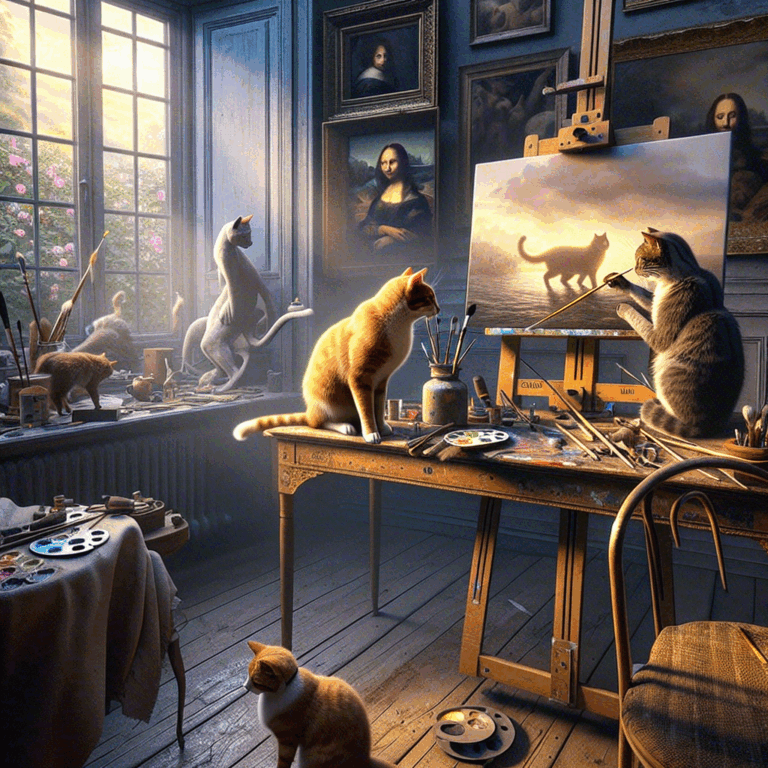






In the world of fine arts, where creativity knows no bounds, cats have long been the silent muses inspiring some of the most renowned artists across history. These enigmatic creatures have not only been subjects of countless paintings and sculptures but have also subtly influenced the techniques and styles that artists employ. This article delves into the historical and contemporary significance of cats in the realms of painting and sculpture, exploring how their presence has shaped artistic expression through the ages.
From ancient Egypt to the Renaissance period, cats have been venerated in art, often appearing in religious and secular contexts alike. In ancient Egyptian society, cats were considered sacred and were frequently depicted in sculptures and wall paintings, symbolizing protection and grace. These early artistic representations laid the groundwork for the cat’s esteemed place in art, which continued to flourish in subsequent centuries.
The Renaissance era saw a flourishing of cat depictions in European art, where they became popular symbols of domesticity and mystery. Artists like Leonardo da Vinci and Albrecht Dürer incorporated feline figures into their works, capturing the lithe elegance and enigmatic expressions of cats. Da Vinci, known for his keen observation of nature, studied the anatomy of cats, which informed his understanding of movement and form, evident in his sketches and studies.
In the 19th century, the Impressionists and Post-Impressionists found inspiration in the everyday scenes of city and countryside life, where cats were often present. Pierre-Auguste Renoir and Édouard Manet, among others, frequently included cats in their works, using their unique presence to convey mood and texture. The Impressionists’ focus on capturing fleeting moments of light and color found a perfect subject in the ever-curious and unpredictable cat.
The modern art movement brought a new dimension to the depiction of cats, with artists like Pablo Picasso and Henri Matisse embracing the abstract and surreal qualities of feline forms. Picasso’s love for cats was well-documented, and he often included them in his vibrant and distorted Cubist compositions, where they symbolized freedom and independence. Matisse, with his bold use of color and fluid lines, captured the playful essence of cats in a way that resonated with his overall artistic philosophy.
Contemporary artists continue to explore the relationship between cats and art, with some using these animals to comment on social issues or to experiment with new media. Digital art and sculpture have expanded the possibilities for depicting cats, allowing artists to explore their forms in innovative and interactive ways. The internet, with its proliferation of cat memes and videos, has further cemented the cat’s status as a cultural icon in the digital age.
Beyond their visual representation, cats have also influenced the techniques artists use in their work. The meticulous observation required to capture the subtle nuances of a cat’s movement and expression has honed artists’ skills in rendering texture, shadow, and perspective. The challenge of portraying a creature so full of character and mystery has pushed artists to experiment with new styles and mediums, leading to breakthroughs in artistic practice.
In conclusion, the influence of cats on painting and sculpture is a testament to the profound connection between humans and these enigmatic creatures. As both subject and muse, cats have inspired generations of artists to explore the depths of creativity, leaving an indelible mark on the history of fine arts. Their presence in art galleries and studios around the world continues to remind us of the beauty and mystery inherent in the natural world, as seen through the eyes of our feline companions.